
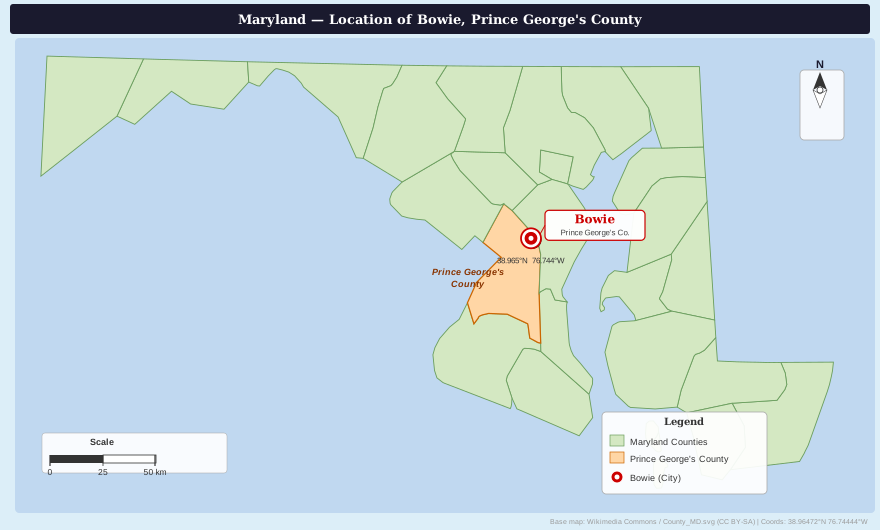
Levitt & Sons — Belair at Bowie
The postwar development that turned horse country into one of the mid-Atlantic’s largest planned suburbs — and the newspaper ads that reveal exactly how it was sold.
After the death of William Woodward Jr. in 1955, Levitt & Sons acquired the Belair estate in 1957 and opened Belair at Bowie for sales in 1960 — the planned community that gave modern Bowie its dominant residential character and remains home to the majority of the city’s residents today. Levitt applied the same assembly-line construction techniques used at Levittown, New York and Levittown, Pennsylvania: standardized house designs, prefabricated components, and crews moving from lot to lot in sequence. The result was thousands of homes on the former farm and racing stable grounds in a compressed span of years. The development was built in phases — the original Belair at Bowie sections, then the Idlewild section, then Pointer Ridge, with the whole eventually rebranded as Belair Village.
For a detailed breakdown of the phased development—home counts, original prices, current median home values (2026), and original vs. current elementary schools—see the full Levitt Neighborhood Sections Table.
Levitt & Sons also practiced racially discriminatory sales policies at Belair at Bowie, as they had at their other developments. 8mm home footage from the period — preserved from Paul Flaherty’s original film — captures the community in its earliest years. The civil rights struggle at Bowie is part of the broader Prince George’s County story of racial change in the postwar suburban boom.
The pitch — what the ads reveal
The newspaper advertisements Levitt ran throughout the late 1950s and 1960s are primary documents of what the development was selling and to whom. The most direct appeal was the comparison to apartment renting. One ad headline read: “See any good 8-room apartments for $145 lately? Not lately…and not likely!” — followed immediately by the argument that $145 a month in Belair at Bowie bought ownership, equity, and deductible taxes rather than a landlord’s rent receipts. Another ad in the same vein opened: “Are you investing in a home of your own — or paying off your landlord’s?” [Ad: investing vs. rent receipts] [Ad: 8-room home for $145]
A second line of appeal was the escape from the city. One ad — headlined “Fresh Air…or Foul? What does your child breathe?” — ran photographs of a suburban street alongside a city apartment building and argued that Belair had no heavy industry, no traffic fumes, and air you could “actually see the difference.” Another pitched the commute: “Belair at Bowie is a pleasant 25-minute drive from Baltimore… you can leave your midtown office after 5, and be ready to sit down to dinner about 6.” [Ad: carefree living, carefree commuting]
One ad’s language is worth quoting exactly in light of the discriminatory sales policies already mentioned: “And, at Belair there are good neighbors. Truly nice people — in government, the professions and executive jobs.” That sentence, unremarkable on its face, was coded demographic targeting — a promise to prospective buyers about who would, and by implication who would not, be their neighbors.
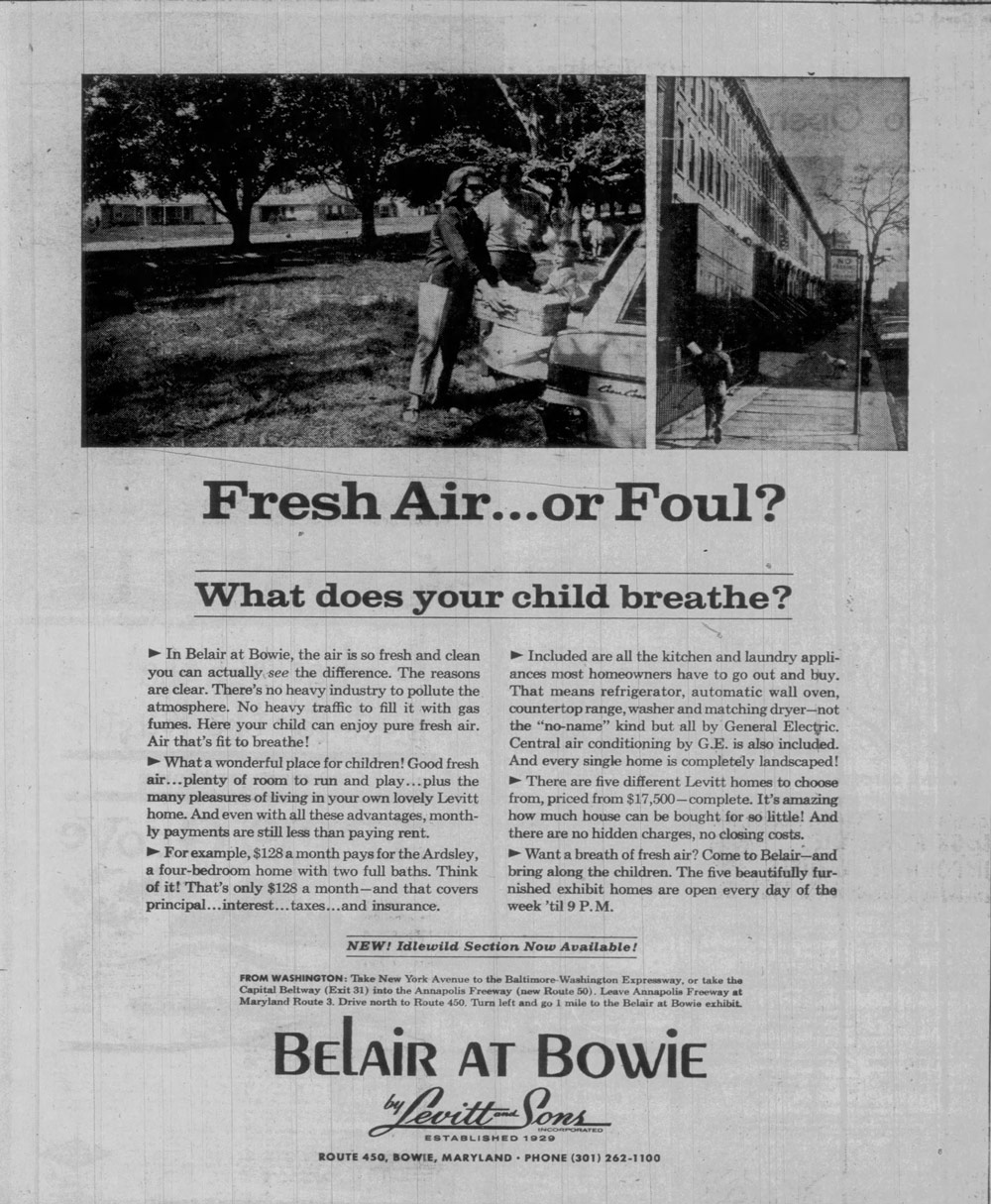
“Fresh Air…or Foul?” Levitt & Sons newspaper advertisement for Belair at Bowie. The ad contrasts suburban Bowie — no heavy industry, no gas fumes — against an urban apartment building. Note the footer: “NEW! Idlewild Section Now Available!” — evidence of the phased expansion of the development. Homes priced from $17,500 complete, with all appliances, central AC, and no closing costs. Via Newspapers.com.
Through European eyes — Suburbia USA, 1965
At almost the same moment Levitt was running full-page ads about fresh air and good neighbors, a West German film crew arrived in Belair at Bowie to document what American suburban life actually looked like from the outside. The result was Suburbia USA (1965), a documentary that followed the Golato family for two weeks, offering observations that were, by American standards, pointed. Translated via subtitles: “Women are the only adults the children see during the day.” “In suburbia the intellectual life is at its lowest.” “A long lawn is a sin.” Al Golato later recalled the experience bluntly: “They had no feeling, no empathy for what was going on in our lives for two weeks.”
The film remained obscure for decades until Bowie-native filmmaker Jeff Krulik — best known for Heavy Metal Parking Lot and Led Zeppelin Played Here — discovered it while researching his own documentary about the community. Krulik’s Tales of Belair at Bowie (2020) weaves Suburbia USA clips between interviews with original Belair residents, moving between nostalgia and reckoning. Krulik also addresses Levitt’s discriminatory covenants directly — including an account by Dr. Karl Gregory of the Congress of Racial Equality, who described attempting to buy a Levitt home in 1962 knowing his offer would be rejected, in order to document the refusal. The film had its public television premiere on Maryland Public Television on February 20, 2021, and is available to stream at talesofbelairatbowie.com and on the PBS app.
Phases and prices
The early Belair at Bowie ads priced homes from $16,500 — a figure that covered everything: seven or eight rooms, central air conditioning by Westinghouse or GE, a full complement of GE kitchen appliances (built-in range, wall oven, refrigerator), a GE automatic washer and dryer, professional landscaping, an ornamental gas lamp at the driveway, and closing costs. There were no extra charges of any kind, and buyers owned the land outright — ads explicitly noted “there is no ground-rent to pay in Belair,” distinguishing Levitt’s terms from the leasehold arrangements common elsewhere. FHA and VA financing were available, and down payments ran to less than 10 percent.
As the development expanded into the late 1960s, Levitt pushed south with Pointer Ridge — a new residential section, bounded by Route 214 (Central Avenue) and Route 301 (Crain Highway), south of Route 50 — the area now known as South Bowie. Homes were priced from $21,500. By the time the full development had rebranded as Belair Village in the late 1960s, the Briarcliff model — three bedrooms, two baths, with central AC — was priced at $25,990, financed on a $23,800 FHA mortgage at 8.25 percent, with monthly payments of $240. The most expensive model in that phase ran to $31,500. The development had by then added six different house designs across ranch and colonial styles. [Ad: Pointer Ridge — Now Open!] [Ad: Belair Village, less than 10% down]
What they promised — and what was built
One Pointer Ridge ad — headlined “Better living for your entire family!” and pitching the full Belair Village concept — contains a description that any current Bowie resident will recognize:
“There will be a picturesque lake surrounded by acres of unspoiled parkland, athletic fields, picnic groves. A lighted lakeside walk, a charming island gazebo, a modern bandshell, a boating pavilion — all are part of the joyous way of life planned for Belair Village.”
That is Allen Pond Park — described in a Levitt sales advertisement at the very moment it was being created. Levitt had purchased the Allen farm land in 1965, and the Robert V. Setera Amphitheater was built in the late 1960s; the 1968 Pointer Ridge ads were running as the park was taking shape, marketing its planned features — the island gazebo, the bandshell, the boating pavilion — to prospective buyers. What James Allen had sold to Levitt as a fishing pond with a community condition attached became the centerpiece of a marketing campaign. The promises were kept: all of those features were built and all survive today. [Ad: Pointer Ridge Park at Belair Village]
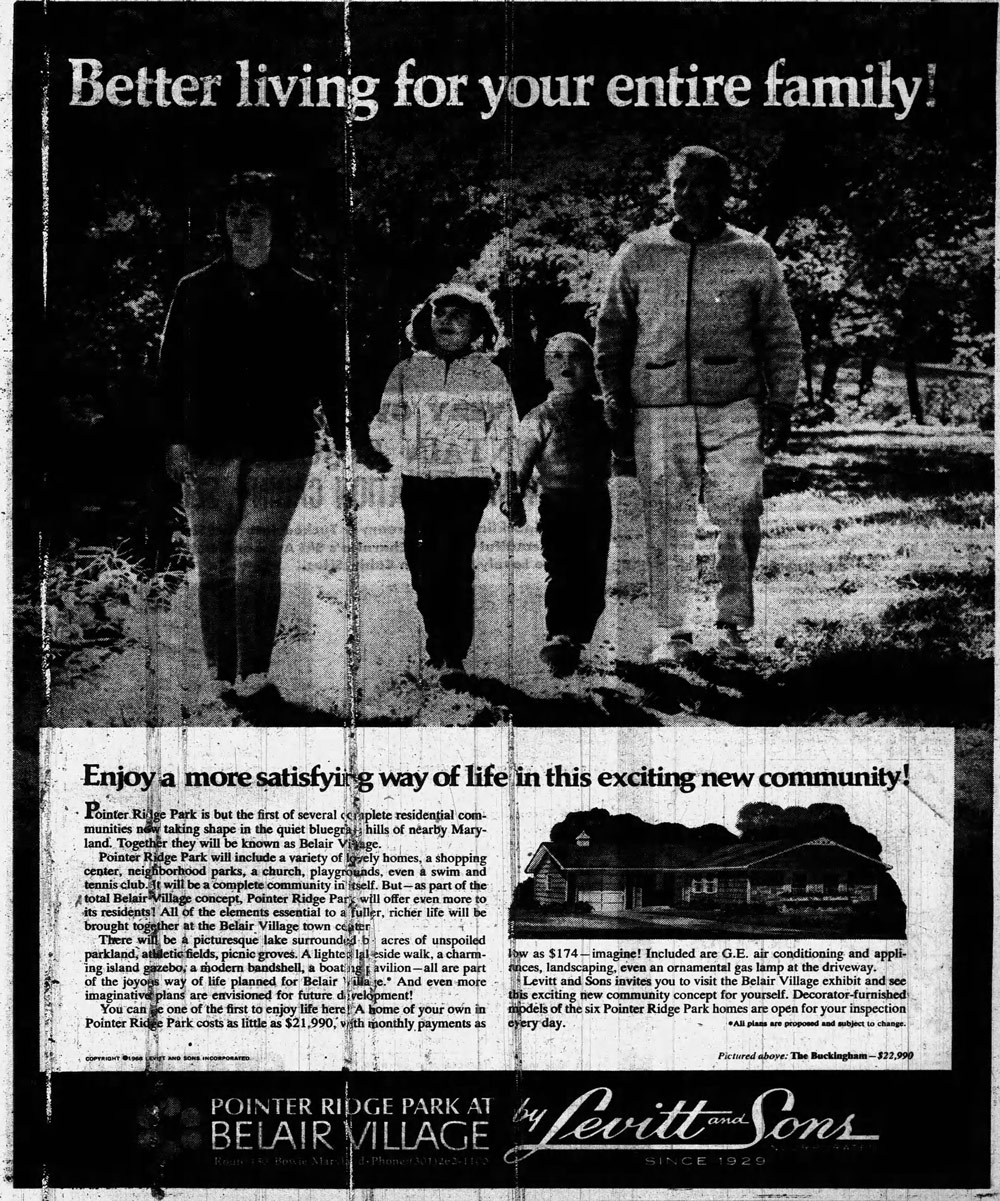
“Better living for your entire family!” Levitt & Sons advertisement for Pointer Ridge Park at Belair Village. The lower right text block describes the planned community amenities — the picturesque lake, island gazebo, modern bandshell, and boating pavilion — that were built as Allen Pond Park and still exist today. “All plans are proposed and subject to change,” the ad notes at the bottom. In this case, they were built. Via Newspapers.com.
The town center that waited 33 years
Not every promise was kept on Levitt’s schedule. A full-page ad in the Washington Daily News on March 22, 1968 — headlined “Now Open! Pointer Ridge Park at Belair Village” — described an ambitious vision that went far beyond single-family homes. Belair Village, the ad explained, was “uniquely conceived as a number of separate and distinctly different residential parks, planned around a picturesque town center and lake.” The plan included not just houses but “apartments, town houses, community buildings, houses of worship” and, at the center of it all, “a variety of convenient shops, services, and an air conditioned shopping mall.” The ad ran a large aerial artist’s rendering captioned “Artist’s conception of proposed Belair Village Town Center” — showing a substantial urban-scale commercial development that reads, in retrospect, as something between a regional mall and a downtown district. [Washington Daily News, March 22, 1968: Pointer Ridge Park ad with artist’s rendering of proposed town center]
The town center shown in that rendering was never built. Bowie would eventually get its own town center — Bowie Town Center, an outdoor lifestyle mall, opened in November 2001 near the interchange of Routes 301 and 50, close to the Pointer Ridge area of South Bowie. It arrived 33 years after Levitt’s rendering promised it, developed not by Levitt but by Simon Property Group, and built as an open-air “main street” concept rather than the enclosed air-conditioned mall the 1968 ad had envisioned. The disclaimer at the bottom of the 1968 ad reads: “All plans are proposed and subject to change.” In this case, they were — for three decades.
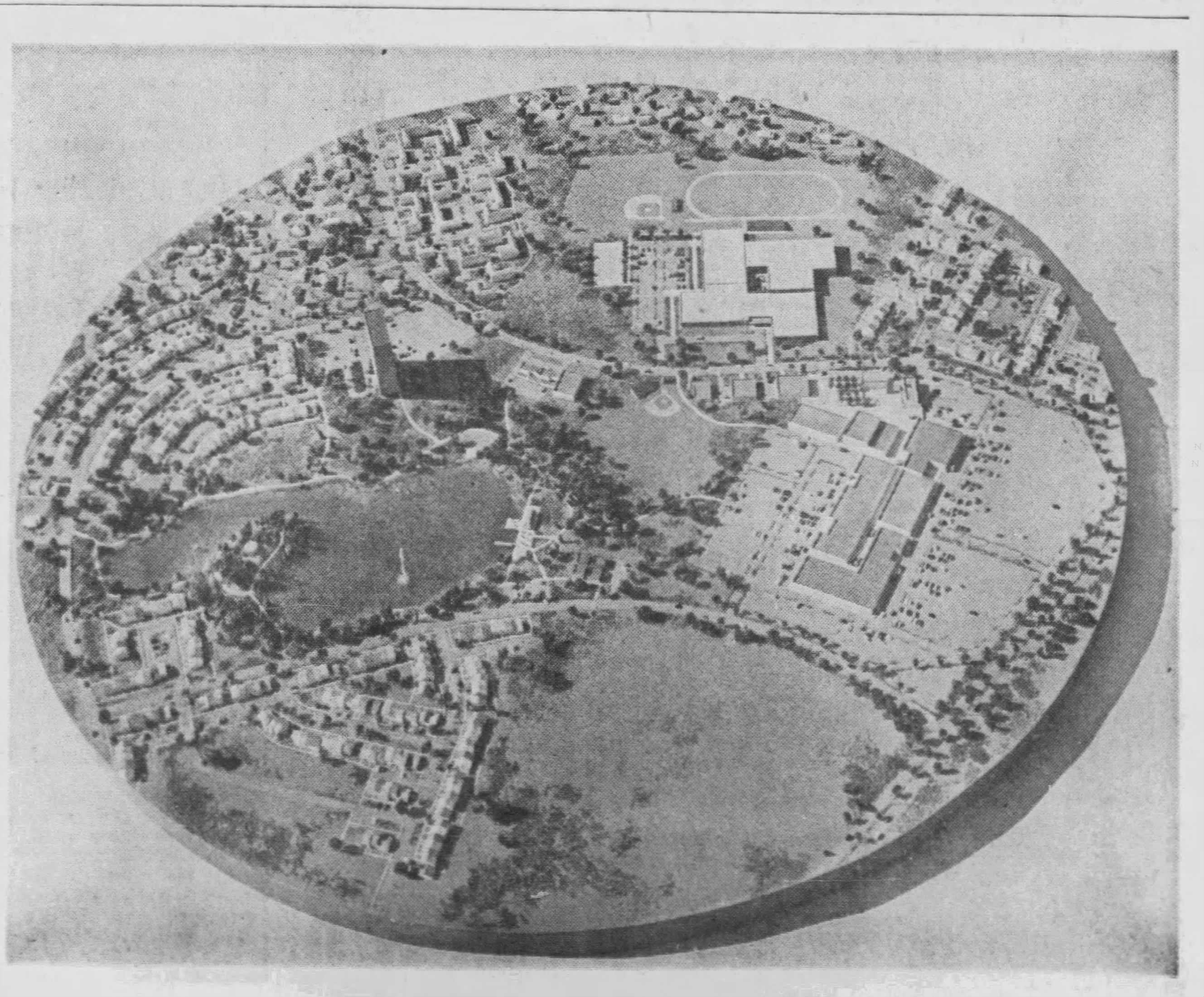
Aerial view of the Levitt and Sons scale model of Belair Village, accompanying the article “Village Work Started” in The Record (Hackensack, NJ), March 15, 1968. The model shows Allen Pond with its wooded island (center left), the mixed-use town center and parking (right), the school campus with running track (upper center), and residential clusters radiating outward. Via Newspapers.com.
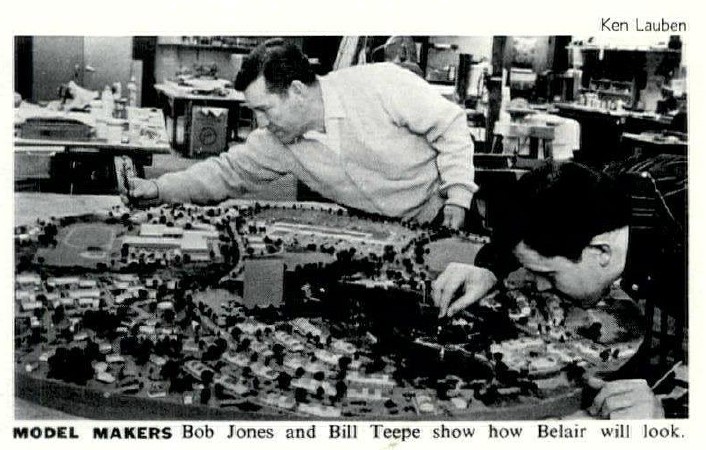
Model makers Bob Jones and Bill Teepe putting finishing touches on the Levitt scale model of Belair Village. Caption: “MODEL MAKERS Bob Jones and Bill Teepe show how Belair will look.” Photo by Ken Lauben. House and Home, April 1968. Via USModernist.
Author’s note — updated April 2026. An earlier version of this note described the 1968 artist’s rendering of the proposed Belair Village town center as possibly “aspirational marketing rather than any serious development plan.” New primary sources have revised that assessment considerably.
A December 6, 1966 architectural site plan — stamped “Preliminary Only” and signed by architect John F. Sierks AIA for Levitt and Sons, Inc. — confirms that Levitt had prepared a detailed, scaled proposal for a substantial mixed-use development centered on Allen Pond. The plan shows high-rise and mid-rise apartment buildings, clusters of townhouses, a junior high school, an upper school campus with auditorium-theater and stadium, an amphitheater (realized as the Robert V. Setera Amphitheater), a boat house and docks, and a community facilities area with reserved sites for a youth center, public library, cultural center, town hall, fire and rescue squad, and community services center. At the eastern edge of the pond, a labeled “Town Square” is surrounded by a community shopping center, offices, medical center, theater, commercial locations, and post office. Total site area was approximately 16 acres, with parking for 140 cars.
Levitt went further than drafting plans: a physical scale model of the community was built by model makers Bob Jones and Bill Teepe and published in House and Home magazine in April 1968 and in The Record newspaper on March 15, 1968. The Record described the project as “a new community with village-like clusters of homes built around a 200-acre downtown and a lake and extensive parks and buildings for community use” to be built in Prince George’s County by Levitt and Sons, Inc. James P. Lee, a Levitt vice president and regional general manager, stated that construction of the town center had already begun and that the first facilities would open that summer.
The House and Home article also identifies Levitt’s stated land-plan model — and it was not Reston or Columbia. Richard Rosen, Levitt’s manager of community planning, named it directly: New York’s Central Park. “The only difference is that we added all types of housing,” Rosen said. Dr. Norman Young, senior vice president of marketing, was equally explicit in both publications that Belair Village was “not a new town” in the Reston or Columbia sense. His critique, quoted at length in The Record: “The immediate investment of millions of dollars in community amenities long before the first customer moves in pushes house prices up to the point where you have, in fact, a community of only high-cost housing.” The Levitt solution, Young said, was to integrate amenities into the total housing picture “in a time sequence that will produce minimum financial strain, thereby enabling us to maintain prices home buyers can afford.” The House and Home article appeared in the context of Levitt & Sons’ recent merger with ITT (International Telephone & Telegraph), with Belair Village cited as the “first practical application” of the company’s expanded goals under new management and new leadership: William Levitt had moved up to board chairman, with Richard Wasserman replacing him as president.
What the new documentation does not resolve is the question of the James Allen park commitment. Allen’s 1965 deed condition required that the pond land be preserved for community park use — the basis on which Allen Pond Park exists today. Whether the December 1966 plan was prepared with the expectation of modifying or working around that condition, or whether the commercial development was intended for land outside the restricted parcel, is not clear from the available record. What is clear is that Levitt’s town center was a genuine and detailed plan, not a marketing flourish — and that it was never built. Why it was abandoned, and what role if any the park commitment played in that outcome, remains an open question.
Forced busing — the largest such program in the nation
A direct consequence of how the suburbs were built across Prince George’s County, and one of the most contested chapters in its history.
In the 1950s and 1960s, suburban growth in Prince George’s County followed national patterns: racially restrictive covenants, discriminatory lending, and real-estate practices that steered Black and white families into different neighborhoods. Levitt & Sons’ Belair at Bowie was one prominent example, but it was part of a broader countywide system that produced sharply segregated housing and, in turn, segregated schools.
In 1972, the NAACP, led by Sylvester Vaughns Sr. and seven other parents, filed suit against the Prince George’s County Board of Education, arguing that the county was maintaining a dual school system in violation of Brown v. Board of Education. In December 1972, U.S. District Judge Frank A. Kaufman ordered a desegregation plan to be implemented primarily through student busing. Busing began in January 1973. A Washington Post report dated January 28, 1973 — the day before the transfer took effect — noted that approximately 12,000 of the affected students had previously walked to their neighborhood schools; they would now ride buses to schools that, in many cases, were five to more than ten miles farther away.
At that point the county was still more than 80 percent white, and the court order produced what would become the largest mandatory busing program ever imposed on a single school district in the United States. For 26 years, Prince George’s County operated under federal court oversight, spending tens of millions of dollars — including more than $20 million paid to NAACP attorneys over the life of the case — moving students across the county by bus in an effort to achieve racial balance.
The demographic shift that followed was dramatic. In the year after the order took effect, the schools lost about 8,000 white students. By 1980, the total loss reached roughly 63,000. Many families moved to Montgomery County; others turned to private schools. The county, which had been more than 80 percent white in the mid-1970s, was only about 27 percent white by 2010. Money that could have gone into buildings, teachers, equipment, and field trips went instead into buses, drivers, and fuel.
A personal account. I was among the students bused under this plan. That meant nearly hour-long commutes each way to junior and senior high near the Washington Beltway — out in the dark mornings and back again in the late afternoon. Missing the regular bus felt like a catastrophe. There was an after-school “activity bus,” but it ran infrequently and on a separate schedule, and for students bused long distances it did not provide dependable transportation home. As a result, after-school activities, clubs, and sports never felt like real options. The schools we were sent to felt culturally foreign — with different norms around behavior and discipline, different musical tastes, and, at times, open hostility, including racial insults and occasional violence. That dislocation was as real in one direction as it was in the other. Almost all of my elementary school classmates either left the county system or switched to private school rather than ride those buses. The official distance figures cited by planners were almost certainly calculated as straight-line distances, without accounting for actual road miles, traffic, or bus route geography — meaning the real distances and time spent on the road were almost certainly longer than the numbers on paper suggested.
Reading filmmaker Michael Streissguth’s statement for The Tower Road Bus, I recognize the same emotion in former students he interviewed, who described being uprooted from their community-based schools and made part of an “integration experiment.” One remembered, “I felt like I was part of a science experiment.” That is very close to how the whole arrangement felt to me at the time: children treated as unwilling pawns in a social experiment, rather than as students with roots in families, neighborhoods, and schools that mattered to them.
The contrast with neighboring Montgomery County, where friends attended well-equipped neighborhood schools with engaged parents, was stark. By senior year of high school, overcrowding had grown so severe that lockers had been installed in stairwells. Eva Cassidy, who attended Bowie High School during the same era, was also affected; her encyclopedia.com biography notes that racist behavior by some white classmates after mandatory busing began deepened her sense of isolation and pushed her further toward art and music.
By 1989, school superintendent John A. Murphy was already acknowledging that magnet programs were no longer an effective desegregation tool because there were too few white students left in the system to make racial balancing work. In September 1998, U.S. District Judge Peter J. Messitte approved a settlement ending mandatory busing; the federal case formally concluded in 2001, and the agreement called for building 13 new neighborhood schools. Even Sylvester Vaughns, the lead plaintiff, later expressed regret about some of the program’s unintended consequences.
The original grievance was legitimate: before 1973, Black students in Prince George’s County often attended genuinely unequal, under-resourced schools. But the remedy chosen did not produce lasting equality of opportunity. It left many Black students in poorly resourced schools anyway, while helping drive out much of the middle-class tax base and weakening neighborhood school communities across the county. From the vantage point of someone who was bused through the system, this chapter feels less like a story of clear winners and losers than a cautionary tale about a real injustice and a remedy that carried heavy costs.
Blacksox Park & the Sandlot World They Built
Long before Bowie had Little League fields and organized youth sports, a different kind of baseball shaped community life along the Route 301 corridor — and the men who played it did so not for pensions or contracts, but for the pure love of the game.
“We Didn’t Have Anything Else”
In the segregated Prince George’s County of the 1930s, ‘40s, and ‘50s, African American families found their recreation and their community largely on their own terms. Public parks and facilities were either closed to them or unwelcoming. Major league baseball — played at Griffith Stadium just across the DC line — was a whites-only institution until Jackie Robinson broke the color barrier in 1947. Into that void stepped sandlot baseball: informal, community-driven, and fiercely competitive. When a former fan of that era was asked why seemingly everyone was involved in the game, his answer was simple: “We didn’t have anything else.”
But they built something extraordinary out of that necessity.
The Mitchellville Tigers: Born in a Cornfield
The story of organized African American baseball in what would become Bowie begins in 1946, on a cornfield. That year, a local man named John Abraham Henry converted his property along Mitchellville Road into a community ballfield, and a team of boys and young men — calling themselves the Wee Wee Tigers — started playing there. By 1948, under the coaching of Frederick Powell, they had grown into a serious organization and adopted a new name: the Mitchellville Tigers. They played on that field until around 1961.
A team photograph from 1948 — preserved by the City of Bowie and in the collection of former Bowie City Council member William A. Aleshire — shows the Tigers in their prime: uniformed, organized, proud. Within a few years they were traveling to Baltimore to face teams like the Baltimore Giants at Westport Stadium, competing at a level that the mainstream sporting press largely ignored but that the Baltimore Afro-American covered faithfully, week after week.
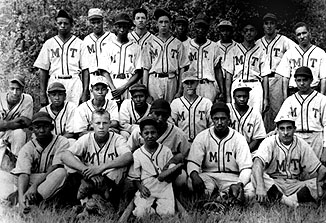
Mitchellville Tigers team photo, circa 1948. The batboy pictured grew up to play on the team. Photo courtesy City of Bowie, Md. and William A. Aleshire. Via Prince George’s County Historical Society.
Doffey Jones and the Washington Blacksox
No figure loomed larger over this world than William “Doffey” Jones. A Washington DC resident with deep roots in the Mitchellville community, Jones founded the Washington Blacksox in 1928 and ran the organization for over six decades. Over that span he built it into the dominant force in the local sandlot circuit. The Blacksox won championships repeatedly; former player Al Burrows, who had himself played professionally with the New York Black Yankees and the Indianapolis Clowns, remembered them bluntly: “They won the championship every year. I don’t think they ever lost.”
In 1961 Jones took perhaps his boldest step, constructing a proper sandlot baseball stadium on Mitchellville Road — on the same site where the Mitchellville Tigers had played since the late 1940s — creating what would eventually be dedicated as Blacksox Park. The Blacksox played there until around 1971, and the organization itself survived until 1992, a remarkable 64-year run.
The Tri-State League
In 1957, the informal network of community teams was formalized as the Tri-State Baseball League — a semi-professional circuit stretching across DC, Maryland, and Virginia. Charter members included the Washington Blacksox, the Brandywine ACs, the Glenarden Braves, the Vista Yankees, the Clinton Yellow Jackets, and two Charles County teams, the Pomonkey Browns and the Bryantown Cardinals. By the early 1960s the league had expanded further to include teams like the Mitchellville Tigers, the Davidsonville Clowns, the Northeast Athletics, and the Arlington Athletics. Teams traveled from as far away as St. Mary’s County and Port Tobacco to compete.
The Baltimore Evening Sun, writing about sandlot baseball in 1953, captured what made this world significant even before the league was formally organized: sandlot baseball, the paper noted, was “one of the biggest organized sports” in the region and “the training ground for tomorrow’s professional diamond stars.” That was no exaggeration. The Tri-State circuit fed scouts for the Negro Leagues and, after integration, for professional baseball itself. Al Burrows’s path from the local sandlots to the New York Black Yankees was not unusual — it was the system working as intended.
One often-overlooked aspect of the sandlot league was its diversity. While the teams were rooted in African American community life, the games themselves drew players of all backgrounds — white players and Native Americans competed alongside Black players on the same fields, at a time when the major leagues remained rigidly segregated.
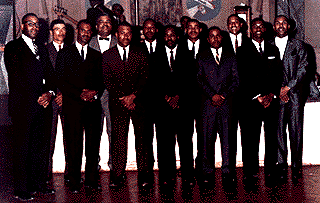
Tri-State League team owners and managers gather at a banquet, circa 1960. Photo courtesy City of Bowie, Md. and William A. Aleshire. Via Prince George’s County Historical Society.
Sunday on the Sandlots
The games themselves were a social institution as much as a sporting event. Most were played on summer Sundays, after morning church services. Families arrived in their Sunday best — hats, suits, and ties — and settled in for an afternoon of serious, competitive baseball. Teams traveled from across the county and beyond, arriving by car or bus. The Baltimore Afro-American ran weekly standings and game results; a doubleheader cost only a dollar, and the baseball was worth every cent.
The fields where these games were played were rarely just ballfields. Across the county, community venues with space to gather — restaurants, social clubs, lodge halls — served as anchors for the sandlot world. Supporters of the Glenarden Braves regularly hosted “chitlin struts” — community fundraising events where food, music, and fellowship raised money to pay for uniforms, equipment, and travel expenses. The baseball diamond and the supper club were two halves of the same social world.
The McJess Supper Club: A Lost Landmark
Nowhere was this connection more vivid than at the McJess Supper Club — known in later years also as the McJess Oasis — a restaurant and nightclub that stood on U.S. Route 301 just north of Mitchellville Road. Behind the supper club sat a baseball diamond that served as one of the community’s informal playing fields, and the venue itself was a natural gathering place for players and fans. The surrounding area included old residential houses that spoke to the established African American community that had long predated the postwar development of Bowie — families who had lived along that Route 301 corridor for generations, who built the Mitchellville Tigers on a cornfield, and who made Sunday afternoons at the ballpark one of the defining rhythms of community life.
The McJess operated as a restaurant and social venue for decades along the Route 301 corridor, its building eventually converted to use as a church — New Visions Church, which still occupies the site today. The baseball diamond behind it is now the lot of Nissan of Bowie. There is no marker. There is no memory, for those who didn’t live it.
The Grays Come to Mitchellville Road
The reach of this sandlot world extended all the way to the professional Negro Leagues. The Homestead Grays — one of the greatest teams in Negro League history — played the Washington Blacksox at the Mitchellville Road field, a testament to the competitive caliber of what was nominally amateur baseball. The Grays and the Baltimore Elite Giants, both championship-level organizations, regularly recruited from the sandlot circuit when they needed to fill their rosters. Players from the Mitchellville community fed directly into those lineups — a pipeline that ran in both directions, with professional teams drawing on local talent even as their stars came back to encourage the next generation.
That encouragement took its most memorable form in 1961, when Walter “Buck” Leonard of the Homestead Grays — one of the greatest first basemen in Negro League history and a Baseball Hall of Famer — paid a personal visit to the Washington Blacksox at their Mitchellville Road field. Leonard understood exactly what the sandlot teams represented: the living roots of a tradition the major leagues had spent decades trying to exclude.
The 1996 Dedication
At the dedication of the newly renovated Blacksox Park on September 21, 1996, some 200 players who had played on the grounds were invited to the ceremony. Buck Leonard, then 88 years old, threw out the first pitch. Former Bowie City Council member William Aleshire — whose book Sandlot: The Soul of Baseball stands as the first written documentation of these local teams — was among those who helped ensure the history would not be lost entirely. A historical marker erected that day by the City of Bowie now stands at the park, commemorating both the Washington Blacksox and the Mitchellville Tigers.
What Remains
Blacksox Park today is a 70-acre public park off Mitchellville Road in south Bowie, home to youth baseball leagues, with five ballfields, a central facility building, and a quarter-mile paved storybook trail† that winds its way through woods to a tot lot on Mt. Oak Road. The historical marker at its entrance is one of the few tangible remnants of the world described here. The McJess Supper Club is gone. The Brentwood Flashes are gone. The Laurel All-Stars are gone. The Oxen Hill Aztecs are gone. The Glenarden Braves are gone. The Davidsonville Clowns are gone.
† A storybook trail places pages from a children’s book at child height along a walking path — a format invented in Vermont in 2007 that has since spread to all 50 states. The featured book at Blacksox Park is It’s OK to Be Different.
But for roughly four decades — from a cornfield in 1946 to a formal stadium in 1961 to the last Tri-State League games in the 1980s — the community along the Mitchellville Road corridor built something the mainstream sporting world never bothered to document: a self-sustaining culture of athletic excellence, community pride, and Sunday fellowship that asked nothing of the institutions that had excluded them, and needed nothing from them either.
They played, as one observer wrote, “for the love of the game.”
Bowie State University — from a church basement to a doctoral university
While the Ogle family was losing Belair to debt and the WB&A was still being planned, a group of Baltimore businessmen and Quakers were opening a school in a church basement for people who had just been freed from slavery. That school is now Bowie State University.
The Baltimore Association for the Moral and Educational Improvement of the Colored People was organized in 1864 by 46 men — businessmen, lawyers, clergymen, and Quakers — committed to opening schools for Maryland’s newly emancipated citizens. On January 9, 1865 — four months before the end of the Civil War — the school opened in the basement of a Baltimore church at Saratoga and Calvert streets. It was called simply “School No. 1.” The first year, it educated 60 students. The goal was not just elementary education but training teachers who could spread literacy through Black communities across the state. The Freedmen’s Bureau, English Quakers, and private donors supported it through the difficult Reconstruction years.
In 1911, the state of Maryland purchased 187 acres of land in Prince George’s County for $5,300 and relocated the school — now called the Maryland Normal and Industrial School at Bowie. The move brought Maryland’s oldest institution for Black education to the same county whose tobacco plantations had once depended on enslaved labor, and just a few miles from Belair Mansion, whose last Ogle owner had freed 41 enslaved people at the Civil War’s end.
The school’s founding principal during its early Bowie years was Don Speed Smith Goodloe, who led the institution for approximately a decade after the 1911 move. Among his accomplishments was establishing Horsepen Hill School — documented as an 1877 one-room school for Black children “just east” of Huntington, and identified in at least one historical source as a Rosenwald school, meaning it received matching grant funding from the Julius Rosenwald Fund, the philanthropic program that built more than 5,000 schools for Black children across the South and border states between 1917 and 1931. The school is believed to have stood on or near the Horsepen Hill rise east–northeast of Old Bowie, in the area that today includes Horsepen Hill Farm off Lloyd Station Road. Goodloe left the school around 1922.
The school expanded incrementally: a two-year program in 1925, a four-year program in 1935, liberal arts added in 1963 when it became Bowie State College, and full university status in 1988 as a founding member of the University System of Maryland. Today it is a comprehensive university of more than 6,000 students with doctoral programs in multiple fields. In 2021, after a 15-year court battle, the state of Maryland agreed to provide $577 million in supplemental funding to four HBCUs — including Bowie State — after a court found that Maryland had violated the Constitution by failing to provide funding that allowed its HBCUs to compete with its predominantly white institutions.
City Hall — from a colonial mansion to a LEED Gold building
Bowie’s city government has occupied three distinctly different buildings, each reflecting a stage in the city’s growth.
Belair Mansion (1964–1978). When Levitt & Sons donated the 18th-century mansion to the City of Bowie in 1964 for $1, on the condition it benefit the community, the city moved its government offices in. City staff worked in a 220-year-old colonial mansion — a beautifully incongruous arrangement that included the mayor’s office, the police station, and the Genealogical Society library all under one historic roof. By 1978 the city had outgrown it entirely; the city manager described the experience of staff scattered across multiple buildings as so fragmented that getting a check issued required a car trip and three days.
Foxhill Elementary / Kenhill Center (1978–2011). As Prince George’s County school enrollment fell from a peak of 162,000 in 1972–73, ten schools were closed in a single year. The City of Bowie acquired Foxhill Elementary — a 40,000-square-foot building originally built for children of the Foxhill section of Levitt Bowie — and converted it into City Hall. The city manager called it like “dying and going to heaven” compared to the scattered mansion offices. Construction workers found beer cans, schoolbooks, and clothes hidden in ceiling recesses during renovation. The building is now called the Kenhill Center and remains in city use for Youth & Family Services and the Bowie Television Studio.
15901 Fred Robinson Way (2011–present). The current City Hall opened in April 2011 under Mayor G. Frederick Robinson, for whom the street is named. The building achieved LEED Gold certification and includes 42 sustainable design features: a partial green roof, water-saving fixtures, light sensors, and reserved parking. It houses the full city administrative staff and the Bowie Police Department.
The Bowie Police Department — authorized by the people
For most of its history, Bowie relied entirely on Prince George’s County Police for law enforcement — an arrangement that grew increasingly strained as the city became the largest municipality in the county with nearly 60,000 residents. In November 2005, Bowie voters approved the creation of a City Police Department by a margin of 77 percent. On September 11, 2006, the city hired its first Police Chief, Katherine Perez, with Deputy Chief John K. Nesky alongside her. By June 30, 2007, fifteen officers were on board. The department has since grown to 57 sworn officers and 21 civilian personnel serving approximately 60,000 residents across 18 square miles.
A personal note. I was riding my bicycle in a park near City Hall when a reporter and cameraman from NBC4 Washington stopped me for an interview about the upcoming vote to create the new Bowie Police Department — a subject I had been following closely and supported. The interview aired. I only found out because colleagues at work told me they’d seen me on television; I never saw the segment myself — which, on reflection, was probably a mercy. I had been cycling at the time and was dressed accordingly, a circumstance unlikely to have lent my remarks the gravitas I would have preferred.
An eyewitness account. On the morning of May 5, 2016, I was at Federal Center SW Metro station when a porcelain third-rail insulator sparked, caught fire, and exploded during the morning rush — sending a fireball across the tracks and scattering debris across the platform after a train had just pulled out. I witnessed and photographed the explosion. That afternoon, CBS Channel 9 (WUSA9) interviewed me on camera about what I had seen. I was able to DVR the broadcast and still have the recording. The incident became a significant Metro safety story: General Manager Paul Wiedefeld, upon seeing the station’s own surveillance footage that afternoon, immediately ordered the station closed and directed crews to replace all porcelain insulators in the system overnight. The US Department of Transportation came close to shutting down the entire Metrorail network in response.
Four schools that became other things — and the shopping centers we grew up with
What became of four elementary schools
When Levitt & Sons completed Belair at Bowie in the early 1960s, every house was a young family and every block had a bike on the lawn. Prince George’s County school enrollment peaked at 162,000 in 1972–73, and Bowie needed elementary schools the way it needed oxygen — there were four of them within walking distance of what is now a single residential neighborhood. As the baby boomers grew up, enrollment fell to 139,302 by 1977–78. Ten schools across the county closed in a single year, and each of the four schools near my home met a different fate still visible in the landscape today.
Foxhill Elementary became Bowie City Hall in 1978, then the Kenhill Center after the new City Hall opened in 2011. It still serves the community, now housing Youth & Family Services and the Bowie Television Studio. Somerset Elementary — which opened in the fall of 1962 and closed at the end of the 1977–78 school year — was converted between 1983 and 1985 by developer Ken Woodring into Somerset Condominium Park, an independent senior living complex: 29 condominium units inside the converted school building and 31 single-story townhouses on the former school grounds. According to the project’s architect, some former Somerset teachers bought units in the building where they used to teach. Buckingham Elementary, which opened in 1964, was demolished and its site became Buckingham Park. The surviving elementary school, a few blocks uphill, still runs. On warm mornings its recess is audible from Belair Drive — a distant, indistinct sound of children, just close enough to be pleasant, just far enough to carry no demands.
Belair Shopping Center, Free State Mall, and the Belair Theatre
When Levitt built Belair at Bowie, the shopping centers that came with it became everyday destinations for the new suburb. On the south side of Route 450, the open-air Belair Shopping Center (later enclosed as Bowie Marketplace) offered deep-fried “broasted” chicken from Mister Chicken — a strictly local operation, remembered by many as one of Bowie’s small landmarks — the Belair Pet Center, Peebles where we’d go to buy dress clothes and Boy Scout uniforms — Peebles later relocated across the street to Free State Mall — and the aisles of the McCrory’s five-and-ten. Out in the courtyard stood “Tommy the Turtle,” a low concrete climbing turtle that every Bowie kid seemed to scale at least once; a replica now sits in front of the Petco at Bowie Marketplace as a nod to the original, though not meant for climbing.
On the north side, the enclosed Free State Mall — climate controlled, with parking for over 2,000 cars — served the Route 450 corridor from the Levitt era through the end of the twentieth century. Its anchor tenants evolved over the decades — an Arlan’s discount store in the early years, succeeded by a Giant Department Store, a unit of Giant Food operating as a general merchandise outlet, then Bradlees, the New England discount chain familiar to anyone who grew up north of New York, then Hochschild’s — the Baltimore department store chain whose Bowie location closed in 1986 — and eventually Sears, whose departure to the new Bowie Town Center in September 2001 effectively ended the mall’s life as an enclosed shopping center. In its prime the mall also had a Fair Lanes bowling alley — duck pins and ten pins both, which is a Maryland tradition, and Fair Lanes itself was a Baltimore-born chain — a Burger King, the Bright Moon Restaurant directly across the hall, a fixture at the mall since 1985, a Ponderosa steakhouse, a Goodyear Tire Center, a sports shop, and barber shops. It devolved into an unremarkable strip center after Sears left, now anchored by a Giant grocery store, TJ Maxx and Ross — a pair of big-box discount clothing and housewares stores — and Bob’s Discount Furniture. Its last longtime specialty retailer, Goodyear Tire, closed years ago and remains vacant.
A personal note. I was a regular customer of Dr. Erick Gray at his optometry practice in Free State Mall. Dr. Gray opened Peepers at that location in 1992 and mentored a young Dr. Nish Patel from the age of 15 — through high school, through Northwestern, through optometry school in Boston — before retiring and passing the Bowie and Gambrills locations to Dr. Patel and his wife Dr. Veera Patel in 2018. Peepers now operates out of Bowie Marketplace across the street from the old Free State Mall site. Dr. Patel’s trajectory resonates: I started working for the federal government as a high school intern, stayed in the same office, and never left — nearly four decades in the same agency. Some people find their place early and simply stay. Peepers has been in Bowie, in one form or another, for over thirty years. That kind of continuity means something in a city that has changed as much as this one has.
Across Superior Lane from the Belair Shopping Center stood the stand-alone Belair Theatre — a single-auditorium movie house, later divided in half with an undulating metal soundproof wall. Parents dropped children off and picked them up later; it was a different era for that kind of thing. The theater eventually closed and was converted into Carousel Carpets & Floors, which also closed. It was eventually replaced by a six-screen multiplex across the street in the Market Place. By the 2000s the Market Place had become a near-empty dead mall; it was demolished in 2015 and replaced with a modern mixed-use center.
Collington Plaza — Pizza Wheel, the Red Lion Inn, and Belair Engineering
Down on Route 301 South stood the third pillar of the Levitt-era shopping landscape: Collington Plaza. It’s gone now — torn completely down and replaced by a Walmart and its surrounding tenants — but in its time it was home to several places that left a lasting mark on anyone who grew up nearby.
Among them was Pizza Wheel, which also had a location at Hilltop Plaza on Route 450. Pizza Wheel made a style of pizza unlike anything from a national chain: an ultra-thin, crackery crust — almost matzo-like in its texture and crispness — with a bright, tangy sauce and toppings that sat on it rather than sinking in. The style has since been described as similar to St. Louis–style pizza, and it was entirely a local thing, deeply associated with Bowie. The taste of a Pizza Wheel pizza, to those who grew up eating it, is not something that fades. The chain eventually closed and the Collington location became a Jerry’s Subs, but the recipe’s reputation outlasted the restaurant by decades — later Bowie pizzerias explicitly advertised “Pizza Wheel style pizza” as a selling point. Cetrone’s Pizza, on the bypassed stretch of old Route 450, kept the cracker-crisp style alive for decades and explicitly advertised itself as a Pizza Wheel–style operation. It too is gone now.
On the north side of the Collington Plaza parking lot stood the Red Lion Family Inn — a distinctive chalet-style building with a steeply pitched roof and Tudor half-timbering. Operated by the Hnatiw family from 1969 to 1984, it was a sit-down restaurant that served as a family dining destination in an era when that stretch of Route 301 had very few such options. A 1971 menu advertisement in The Capital gives a vivid picture of what it offered: sirloin steak for $1.99, a 12 oz. T-bone for $3.59, fried shrimp for $1.99, and a quarter-pound hamburger and fries for 79 cents — all served seven days a week, 11am to 9pm. It occupied the site where the Walmart sign now stands. Like the plaza itself, it is entirely gone, leaving only the memories of those who ate there.
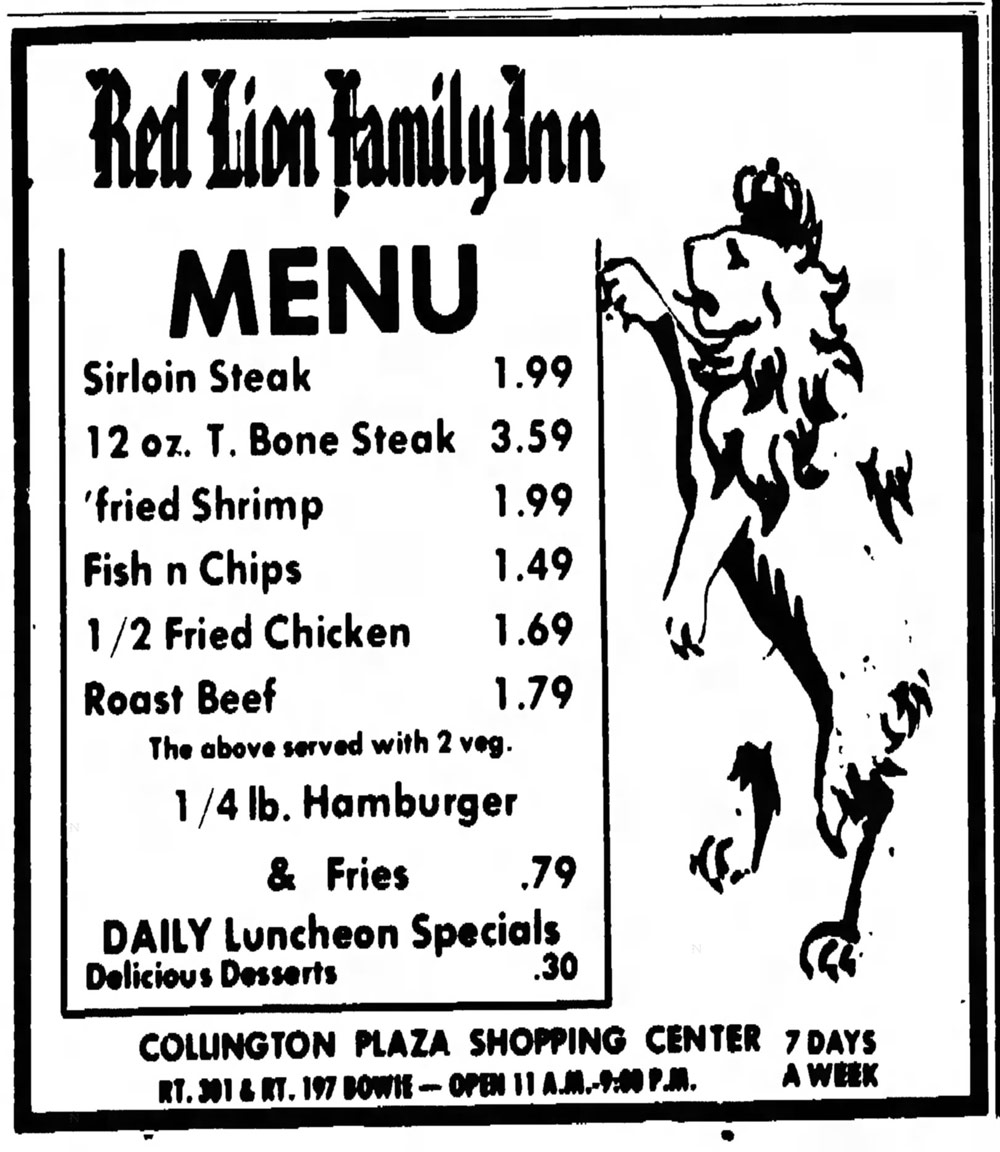
Red Lion Family Inn menu advertisement, The Capital, June 4, 1971. Collington Plaza Shopping Center, Rt. 301 & Rt. 197, Bowie — open 7 days a week, 11am–9pm. A 12 oz. T-bone steak for $3.59; a quarter-pound hamburger and fries for 79 cents. Via Newspapers.com.
Also at Collington Plaza were the hardware and garden stores operated by Belair Engineering. Founded by Bob Herring in 1962 — the year Levitt houses were still going up, and notably the year Herring noticed the Levitt homes had no gutters and started a business to install them — Belair Engineering grew into a full-service home services company with two Collington Plaza hardware stores stocked specifically for what a Levitt homeowner needed: the right sizes, the right fittings, the right knowledge about the quirks of a mass-produced house. When the big-box stores arrived in the 1990s, Belair Engineering wisely retreated from retail and refocused on heating and cooling — the company still operates today, now in its second generation. The hardware gap they left was filled for a time by Hardware City, a local shop that carried on the tradition of a knowledgeable neighborhood hardware store before it too eventually closed.
Beltway Sniper — Terror Comes to Bowie — Shooting at Benjamin Tasker Middle School
The morning the region-wide terror came to Bowie — a single shot from a wooded hide in Foxhill Park that left a 13-year-old boy fighting for his life and a community confronting the same fear that had already paralyzed the Washington area.
On the morning of October 7, 2002, at 8:09 a.m., 13-year-old Iran Brown was shot in the chest moments after his aunt dropped him off in front of Benjamin Tasker Middle School on Collington Road in Bowie. The bullet came from a wooded area roughly 140–150 yards away — the tree line between the school grounds and Foxhill Park next door. Police recovered the shell casing in those woods and later cleared brush in the area, believing the shooter had fired from concealment there.
Iran’s aunt, Tanya Brown, a registered nurse, was already pulling away when she heard the shot. She looked back, saw her nephew on the ground, and immediately put him back in the car. She drove him straight to the nearby Bowie Health Center emergency room — the rapid response that doctors later credited with saving his life. Iran was airlifted from there to Children’s National Hospital in Washington, where he underwent hours of surgery for severe damage to his spleen, stomach, pancreas, lung, and diaphragm. He survived and later testified against Muhammad at trial. A shell casing and a Tarot “Death” card — inscribed “Call me God” — were recovered at the scene.
The shooting was the eighth confirmed attack in the Beltway sniper series that ultimately left ten people dead and three wounded. Because the victims were chosen at random while engaged in ordinary suburban routines — pumping gas, mowing lawns, sitting on benches, or walking into school — the entire Washington region lived under a sustained, low-level terror for 23 days. Gas stations hung tarps around the pumps; many drivers crouched behind their cars or stayed inside and reached out the window to fill the tank. Schools went into “code blue” lockdowns. Parents kept children indoors. Outdoor activities were canceled. Bowie, like every other community along the Beltway, felt suddenly and profoundly exposed.
A personal account. I stopped at the Food Court at the Bowie Town Center on the way home from work on the day of the incident, just down the road from Benjamin Tasker Middle School. The Food Court was never really busy, but on that day it was absolutely empty. I had been at work and hadn’t followed the news. I learned of the shooting from the person behind the counter at Panda Express. Bowie had always seemed like one of those quiet, safe suburbs that stayed out of the headlines; that afternoon it felt as though our everyday anonymity had been ripped away and we were suddenly living inside the same national nightmare everyone else was watching on television.
Growing up in Bowie — childhood at the edge of suburbia
A personal account of what it was like to be a child in Bowie during the years when the suburb was still surrounded by farmland, every house had kids in it, and the world outside your door was vast and mostly unsupervised.
To grow up in Bowie in the 1970s and early ‘80s was to inhabit a world that no longer exists — a particular moment suspended between the farm country that Bowie had only recently been and the fully-built suburban landscape it was rapidly becoming. For those of us who were children then, it was, for a time, something close to paradise.
Nearly every house on every street had children in it. The subdivisions Levitt built were designed for young families, and young families they got — by the dozens, block after block, in the alphabetically-named streets and cul-de-sacs of Belair. On summer evenings, fathers would often gather the neighborhood kids out in the street for impromptu baseball games or whatever sport the season demanded, the cars yielding without complaint. It was ordinary then; it seems remarkable now.
Free-range children
We were, in the language of our generation, free-range children. Parents would put us outside after breakfast and not expect to see us again until lunchtime — or darkness, whichever came first. We rode our bikes everywhere, not just through the neighborhood but far beyond it, into territory that, strictly speaking, we had no business being in. The woods and farm fields that still surrounded Bowie’s developments in those years were irresistible. We didn’t know we were trespassing and, honestly, wouldn’t have cared. There was something out there — a sense of open country just a bicycle ride from home — that felt like genuine wildness, even if it was just a soybean field.
My bike was a second-hand Schwinn with a banana seat — not the famous Stingray 3-speed that defines the Gen X bicycle memory, but a simpler fixed-gear version with coaster brakes and no pretensions. One speed, no shifter, no ceremony. What it lacked in sophistication it made up for in a particular physical sensation that I found genuinely thrilling: coasting downhill with your legs lifted clear of the pedals, the cranks spinning freely beneath you, speed building without any effort on your part. You had to trust the bike and the hill and your own balance, and for a child that combination felt like freedom in its most concentrated form. The bike was stolen off our front porch. I missed it for a long time.
Back in our own yards, the equipment of the era was universal: a metal swing set, a sandbox, and hours of unstructured time to fill both. The sandbox was a serious enterprise — we’d spend entire afternoons constructing road systems for Matchbox cars, fortifications, or whatever the imagination demanded. The big 12-inch GI Joe figures of the era were the presiding generals of these operations, standing over whatever underground civilization we’d decided to excavate that week.
Atari, handheld games, and the arrival of screens
For the wealthier families on the street, a development arrived around 1977–78 that changed the social calculus of after-school hours: the Atari 2600. The original console retailed for nearly $200 — a fortune at the time — so it was concentrated in a few houses, which promptly became the destination of choice on rainy days. The games were crude by any later standard, but we were transfixed. To a child who had grown up with nothing more interactive than a television set, watching a blocky rectangle deflect a blinking square was the future made visible.
For kids who couldn’t afford an Atari, there was a more democratic alternative: the handheld LED games that Mattel and Milton Bradley put out in those years — primitive, beeping little devices with red blinking dots standing in for football players or incoming missiles. Kids brought them to school constantly, tucked into jacket pockets, pulled out the moment a teacher’s back was turned. The most famous was Mattel Electronics Football (1977), which felt like genuine technological wizardry. Milton Bradley’s Simon — the round, four-colored light-and-sound memory game — was in a category of its own: less a game than a compulsion. Both survive today as Hasbro products, a fitting coda for toys that outlasted the companies that made them. I still own both.
What some of us carried
The street looked the same from the outside — the same Levitt houses on the same lots, the same bikes on the same lawns. It was not the same from the inside. My father left when I was in sixth grade. Child support enforcement in Maryland in those years was largely theoretical — crossing into Virginia was sufficient to avoid it, and a lawyer helped. My mother, who had been a stay-at-home parent since they married and had only a high school education, had neither a lawyer nor any practical recourse. After that, we were raised by a single mother on public assistance: AFDC, food stamps, LIHEAP for the heating bills, food banks when needed. This was not something spoken about openly in the neighborhood, but it was not uncommon either, particularly after the demographic shifts that followed forced busing.
Food stamps in those years were physical paper bills — small booklets of denominations printed in pastel colors that looked, as everyone said, exactly like Monopoly money. Getting them required a trip to the government assistance office in Hyattsville: a waiting room, the whole bureaucratic apparatus of public assistance. I accompanied my mother on those trips. I knew what we were there for. I understood, in the way children understand things before they have words for them, that we were making a trip most families on our street were not.
The grocery store was its own education. My mother paid with food stamps. Other shoppers noticed. The looks were usually pitying; occasionally something sharper. And sometimes — I remember this more clearly than I might have expected — a male shopper would offer some form of assistance: to pay for something, to help in some way. I have thought since about what those moments cost my mother, maintaining her composure at the checkout line of a Levitt-era supermarket in a suburb that had been designed and sold as a place where that kind of scene wasn’t supposed to happen.
During the Reagan administration we also received government cheese — the five-pound blocks of surplus cheddar distributed to families on public assistance under the Temporary Emergency Food Assistance Program, beginning around 1981. The cheese was real and it was good, which is something that tends to get lost in the cultural joke the phrase has since become. For the families who received it, it was food.
None of this was visible in the street baseball games, or at Allen Pond Park, or in the acting classes at the community center. Childhood has a way of equalizing the surface of things. But the Atari was at someone else’s house, and the Stingray 3-speed was someone else’s bike, and the trip to the government office in Hyattsville happened on the same calendar as everything else.
After he left, visits were rare, and then they stopped altogether. I didn’t see him again until I had started working downtown as a high-school student intern and discovered that he was working in that part of the city too. He took me to lunch a couple of times.
Watkins Park, community theater, and summer rituals
For summers, there were day camps at Watkins Regional Park — a sprawling M-NCPPC facility near Kettering operating since the late 1960s — and, more memorably, acting classes at the local community center led by a young woman who was herself studying theater in college. I can no longer recall her name, but I remember the work vividly. I appeared in numerous productions, most of whose titles have dissolved into time. Two I remember clearly: Yankee Doodle Dandy, in which I apparently distinguished myself, and a spoof of the Winter Olympics in which I played an announcer. I also played Santa Claus in one production. I kept at it through sixth grade, when other things took precedence.
Sunday evenings in summer had their own ritual: concerts at the bandshell in Allen Pond Park. Bluegrass, folk, local bands of every description — the city put on free shows every Sunday from Memorial Day through Labor Day, and families would spread blankets on the grass and stay through the evening. What I remember as much as the music itself is the stand of pine trees along the upper edge of the concert lawn, separating the audience from the parking lot — a fragrant border that filtered the evening light and dropped pine cones for us to collect. Those Sunday concerts are still going: the City of Bowie continues to host them every summer, free of charge, every Sunday at 6 p.m., a tradition that has run for decades without interruption.
Loss, tragedy, and community
Bowie was not only childhood pleasures. There was a girl who lived on a nearby street who had cystic fibrosis — a genetic disease that, in those years before effective treatments, could take a child before they had much chance at a life. She was simply among us, part of the neighborhood fabric, and her survival depended on daily chest physiotherapy: someone would rhythmically pound on her back and chest to loosen the mucus the disease constantly laid down in her lungs. Her family could not do it alone, and so the neighbors took turns. That is the kind of community that street was — people stepping up, without drama, to keep a child alive. She died anyway, as so many CF patients did in that era, and her absence was felt the way only the loss of a child can be felt.
There was a teenager from across the street who laid down on the Pope’s Creek railroad tracks — the old Baltimore and Potomac line that had defined this town since 1873 — and was killed. And there was a boy struck by a car, possibly while delivering newspapers. Children remember strange details in the aftermath of tragedy, and what we remembered, and talked about in the hushed way that children process the unthinkable, was that his shoes were found far from his body. That detail has never left me.
Farm country at the door
There was a working farm near our house, close enough that when the animals escaped — as they occasionally did — they simply wandered into the neighborhood, as if the boundary between suburb and countryside were as porous as it really was. In those years it still was. Bowie’s older section, Huntington — Old Bowie — remained distinct from the Levitt development, with its own history and character. Beyond it, the Highbridge area was still horse country, with farms and pasture that had not yet given way to development.
The transformation came steadily, and then all at once. One by one, the woods between Bowie, Largo, and Upper Marlboro fell to bulldozers. What had been a vast open expanse of fields that everyone simply called “the Turf Farm” — because that is largely what it was — is now the Fairwood community, thousands of homes on land that once grew grass for suburban lawns elsewhere. The two-lane roads surrounding Bowie — Route 214, Mitchellville Road, Route 197 — have been widened and signalized into something unrecognizable. Before Northview Drive was extended through to Mitchellville Road, you had to drive through Allen Pond Park to get from South Bowie to North Bowie — which gives some sense of how loosely connected the two halves of the city were. Route 50 was always the true dividing line, each half with its own rhythms and its own Boys and Girls Club. Huntington — Old Bowie — stood apart from both, with its railroad history and its own distinct identity.
Forced busing and the neighborhood that changed
When U.S. District Judge Frank A. Kaufman ordered Prince George’s County schools to desegregate by busing in 1973, the impact on Bowie neighborhoods was felt within a year or two. The families who could leave — who had the resources to move to Montgomery County, Howard County, or pay for private school — did. They left quickly and in large numbers. The houses they vacated filled with new residents who, often, did not have young children. The critical mass of kids on the street — the thing that had made those streets feel alive, that had made the baseball games in the road possible — began to thin. Streets that had been dense with children became quieter. The community was not destroyed; it was altered, and the alteration was visible to anyone paying attention, even a child.
Star Wars and the Hampton Mall theater
Every Gen X child has a version of the same story: where were you when you first saw Star Wars, and how many times did you see it? For me, the answer to the first question is the theater at Hampton Mall — the enclosed shopping center on Route 214 in Capitol Heights, near the Capital Beltway. The answer to the second question is twice, which by the social arithmetic of the summer of 1977 made me something of an underachiever. I knew kids who saw it five, seven, ten times — kids who memorized the dialogue, who could recite the crawl, who returned to the theater the way you might return to a church. I was content with two viewings. The film had done what it needed to do.
What it did was hard to explain to anyone who didn’t experience it in a darkened theater in 1977. There is a That ’70s Show episode where the gang goes to see Star Wars and Kelso walks out transfigured — transported, barely able to speak, operating in a register somewhere beyond ordinary excitement. That is not a caricature. That is accurate. The film proposed a different scale of imagination than anything that had come before it, and a child who encountered it in the right theater in the right summer was not the same child coming out as going in.
Landover Mall — the cathedral of Saturday
For many Bowie families — particularly those in South Bowie — the regional shopping destination was Landover Mall, off Route 202, built by Lerner Enterprises and opened in 1972 as one of the largest enclosed malls in the Washington metro area. Getting there required a trip through Prince George’s County on roads that were, in those years, far less trafficked and far more lightly signalized than they are today — a drive that felt routine in a way it would not now. The mall had four original anchor stores: Hecht’s, Woodward & Lothrop (Woodies), Garfinckel’s, and Sears. Woodies and Garfinckel’s were the upscale end. Garfinckel’s in particular occupied a rarefied tier — it was a Washington institution, a name that carried a specific weight that a child absorbed without being told anything explicit. We did not go in. We knew, in the way children know things without being told, that Garfinckel’s was not for us. We walked past it.
The defining architectural feature was the fountain at the mall’s center — actually three circular pools whose configuration echoed the cloverleaf interchange of the Beltway just outside, a design that became the mall’s logo. You could hear the fountains from almost anywhere in the building; their sound was the mall’s ambient signature. During the holiday season the center fountains were drained and the space staged as an elaborate seasonal display — snowmen, reindeer, a gingerbread tableau, something billed as a Cupcake Boat Ride. Whether Santa Claus appeared somewhere separately in the mall’s considerable footprint, or whether my memory has placed him into the fountain staging where the record suggests he wasn’t, is a question I can’t fully resolve. What I remember is the transformation: the draining of the fountain was itself an announcement that the year’s calendar had turned.
The other thing I remember is the color. Landover Mall was brown. Not occasionally brown, not brown-accented — comprehensively, committedly, unapologetically brown. Brown carpet, brown paneling, brown storefronts, in every shade of brown the 1970s could produce. It is jarring to think about now, the way all the design certainties of that decade are jarring in retrospect, but at the time it simply was what a mall looked like.
Carvel Ice Cream was positioned just inside one of the entrance corridors — close enough to the door that you barely needed to step into the mall proper to reach it, which made it the obvious first or last stop of any visit. It was the destination for birthday celebrations among the children I knew. The staff wore white uniforms and pointed paper caps — a presentation that belonged, even at the time, to an earlier era of the soda-fountain world. When a birthday party arrived, there was a ritual: the staff would bang a drum, parade out from behind the counter, and sing, bearing a towering ice cream sundae that no child could finish alone but every child tried. I attended several of these celebrations. The combination of the drum, the white uniforms, and the sundae produced a reliable effect on the birthday child that was indistinguishable from shock.
The mall had a six-screen theater in the basement, reached by its own escalators. I don’t remember ever going to it. By the late 1980s the theater had closed, and by 2002 the mall itself had shut down. Sears hung on longest — it owned the land beneath its building rather than leasing it, and continued operating as a freestanding store after everything around it had gone dark. Sears finally closed in March 2014. The entire site was demolished; the property sat vacant for years, the subject of various development proposals including, at one point, a potential FBI headquarters. The Garfinckel’s sign was found still intact by demolition crews in 2006, on the interior wall of an anchor store that had been dark for sixteen years. All of it is gone.
Big Brothers and the Greaseman
At some point during those years, my mother took me to Prince George’s Community College in Largo, where I was signed up for the Big Brothers program. I was terrified of the prospect. The arrangement, as I understood it, was that I was to spend time with a stranger, on a regular basis, for reasons I only partly grasped. That this was intended to help was something I accepted intellectually while experiencing entirely as dread.
The young man I was paired with lived in Davidsonville — the rural community southeast of Bowie that, in those years, still felt genuinely separate from the suburban corridor. He had a small pickup truck, bought new because trucks were priced more cheaply than cars at the time, with a manual transmission. On weekends, my mother and I would scan the newspaper for events worth attending, and one of those events was a personal appearance by Doug Tracht, known on the air as the Greaseman — at that point the most popular morning radio personality in Washington, broadcasting on WWDC-FM’s DC-101. He had arrived in 1982, replacing Howard Stern in the morning slot, and had built an audience of millions on the strength of what he did better than anyone else on the dial: tell stories. Not anecdotes — stories, with recurring characters, a private vocabulary he had developed over years that listeners gradually decoded like a second language. I had been recording his stories off the air onto cassette tapes, an act of archival devotion I performed with the seriousness of someone who understood that the thing being recorded was worth keeping. If I look hard enough, I may still have some of those tapes.
We came away from the event with a signed photograph, which has long since disappeared. I don’t remember that young man’s name. I only did the program for about a year, and I certainly didn’t appreciate at the time what he was doing — which was, I understand now, blessed work. An ordinary person, with a pickup truck and a free weekend, giving his time to a kid who had no particular claim on it. I have thought about him intermittently ever since.
Stay in School — a pathway forward
The context for what follows — my first credit card, my spending, my computer setup — is a program called Stay in School, which I enrolled in during eleventh grade. Its premise was direct and its target audience was explicit: it was designed for students who might otherwise have to leave school because they couldn’t afford not to work. The program paired young people with federal government employers, placed them in summer jobs before their senior year, and then structured the senior year around that employment. My course load was three classes — one of which was taught by the school’s program administrator, a combined course in typing, business responsibility, and how to present yourself to an employer. That administrator’s role extended beyond the classroom: she visited employers periodically and gathered reports from our supervisors, using that information to determine and document the academic credits we needed to graduate. The school coordinated with the employers, and students earned credit for work performed. For kids on the economic margins of a suburb that had been designed and sold as a place of middle-class security, it was a structured way out.
I was one of the youngest in my cohort — fifteen at the time, which presented a practical problem. Working before sixteen required a special permit, and the program administrator accompanied me in person to a DC government office to apply for one. That detail has stayed with me: an adult from the school going out of her way to move one fifteen-year-old through the bureaucratic machinery of getting a work permit. I was also, as it happened, the only male participant at my school that year.
I mention elsewhere in this essay finding my father working downtown during my years as a high-school student intern. That is what I was — a Stay in School participant, employed in the District before I was old enough to drive.
Decades later, when I retired, I learned that four of us from that program — drawn from different schools, different years — had spent our entire careers at the same agency. We had all started young enough that our years of service were, by any ordinary reckoning, remarkable numbers. We had all risen through the ranks. Whether the program’s architects imagined that outcome, I don’t know. But four people who might not have found a way forward found one. That, I think, is what a well-designed program looks like.
Makro — before warehouse clubs were everywhere
A later memory connects back to that same stretch of Route 214. Once I was working and had joined a credit union, the membership entitled me to shop at Makro — a European-style self-service wholesale center that had opened in February 1981 in the Hampton Industrial Park just behind Hampton Mall, and was one of the very first warehouse clubs in the United States. Access required qualifying organizational membership: credit unions, businesses, tax-exempt groups. The general public couldn’t simply walk in, which gave the place a slightly exclusive quality that bore no relationship to its actual atmosphere, which was pure industrial warehouse.
What I remember most vividly is the cart escalator. The store had two levels, and rather than a conventional escalator, there was a moving belt inclined at a shallow angle — and your shopping cart went on it with you. The cart wheels had grooves machined into them that locked onto ridges in the belt surface, holding the cart firmly in place for the ride. Experienced for the first time, it was the kind of small engineering marvel that lodges permanently in memory.
Makro also issued its own store card, which was my first credit card. I was not responsible with it. I racked up a notable debt, which is perhaps the most universally relatable part of this memory. Among the things I bought on that card was a Royal electronic typewriter — a daisy-wheel machine with a Centronics parallel interface that allowed it to function as a printer when connected to a PC.
Around the same period, I came across a warehouse liquidation sale — a computer reseller had gone out of business, and the inventory was being sold at a substantial discount, the kind of price that made a machine like this accessible to someone piecing together a setup on a first job. That is where I picked up a Leading Edge Model D — the IBM XT-compatible manufactured in South Korea by Daewoo, sold in the US by Leading Edge of Massachusetts, and named PC Magazine’s “clear winner” among budget compatibles at its 1985 launch price of $1,495. I did not pay $1,495. The sale, as it turned out, had a footnote: a man who was also there that day, browsing the same liquidated stock, would later become something of a PC tech mentor to me at work. He bought a Leading Edge too — but where mine was the base model, a single-speed 4.77 MHz machine with no options, he picked up a later turbo variant with a switch on the back that let you toggle between 4.77 and 7.16 MHz. I was jealous.
The workflow I assembled from these purchases was, in retrospect, more sophisticated than it looked. I wrote school assignments on the Leading Edge using WordPerfect and printed them on the typewriter. The result was a document that looked exactly like it had been typed on a typewriter — because it had been. Teachers were visibly surprised when I turned in papers with that quality. Few students at the time had personal computers, and those who did printed on dot-matrix machines, with their characteristic horizontal banding and perforated edges. I was turning in papers that looked like they had been produced on a typewriter. They had been. I was a senior in high school and later in college through this period. The Royal is still somewhere in my possession. I have no idea whether it still works.
Makro’s US operations were acquired by Kmart in 1989 and converted to Pace Warehouse stores, which were themselves eventually absorbed into the Sam’s Club and BJ’s ecosystem. The warehouse club is now a thoroughly ordinary institution. In 1981, in a Hampton industrial park, it was something genuinely new.
What we had was real, and it was brief. Bowie in those years existed in a particular window — after Levitt had finished building and before the demographic shifts and development pressures had fully remade it. For those of us who were children there then, it was something we did not know enough to mourn until it had already passed.
The Bowie Playhouse — “Theater in the Woods”
The Bowie Playhouse has its roots in the earliest years of Levitt Bowie. In the mid-1960s, a group of residents committed to theater founded the Belair Community Theatre — storing sets in member garages, rehearsing in empty storefronts at the Belair Shopping Center, and performing first in the local elementary schools and then in the multipurpose room of the newly opened Bowie High School. The company incorporated on February 16, 1967, and later took the DAV Hall on Route 197 as a cabaret-style venue before the City of Bowie constructed a dedicated theater building in Whitemarsh Park.
That building opened in 1976 and was quickly nicknamed the “Theater in the Woods” for its tucked-away position at the back of the park — the same park that contains Williams Plains, a Georgian plantation house begun circa 1813. The nickname caused so much confusion (audiences repeatedly asked where they were supposed to go in bad weather, not realizing it was an indoor theater) that the BCT board eventually petitioned the City Council to rename it. It has been the Bowie Playhouse ever since.
The theater was renovated in 2008 and now seats 150 in a fully accessible house with a professional fly system, LED lighting, and technical staff that punches well above its size. The Belair Community Theatre eventually renamed itself Bowie Community Theatre to reflect the city’s identity. Two resident companies — Bowie Community Theatre and 2nd Star Productions — run productions year-round, and the Playhouse has earned numerous WATCH awards and British Embassy Ruby Griffith awards over the decades. Fittingly for a theater long known as the “Theater in the Woods,” the trailhead for Whitemarsh Park’s walking and biking trails lies just behind it.
Bowie Center for the Performing Arts — the theater Bowie High School waited 30 years for
An auditorium for Bowie High School had been on the Capital Improvement Program for over thirty years. Maryland’s own funding rules made it impossible to build through normal channels. The community built it anyway.
Thirty years on a list
Bowie High School is one of the largest high schools in Prince George’s County. For most of its history it had no proper theater — performing arts students used gymnasiums, cafeterias, and multi-purpose rooms, making the best of spaces designed for everything except performance. The problem was structural: Maryland State Department of Education rules restricted state funding for additions or auditoriums to existing school buildings, which meant the Board of Education could not use standard educational capital funds to build one, no matter how many times it appeared on the Capital Improvement Program list. It appeared on that list for over thirty years.
The workaround: BRAVA
The community’s solution was to go around the funding restriction entirely. In 1995, volunteers representing all parties interested in a community-based performing arts facility organized a coalition. The Bowie Regional Arts Vision Association, Inc. — BRAVA — was incorporated as a private 501(c)(3) nonprofit and formally authorized by the Prince George’s County Board of Education in 1996 to construct what became the Bowie Center for the Performing Arts. A private nonprofit could assemble funding from sources that state education money couldn’t reach, with the school system then becoming a governing partner in the finished facility rather than its builder.
The entire facility was built with no Board of Education funds. Money came from the State of Maryland, Prince George’s County, the federal government, the Maryland-National Capital Park and Planning Commission, the City of Bowie, and private donors through BRAVA. Gordon Stewart, BRAVA’s founding president, led the organization through its first decade of fundraising and construction — a volunteer effort that outlasted the patience most community campaigns manage to sustain.
The facility
The Bowie Center for the Performing Arts opened with a gala in 2004, immediately adjacent to Bowie High School at 15200 Annapolis Road, sharing a parking lot with the public library. Its two performance spaces are an 800-seat main auditorium and a 150-seat recital hall and community room, originally named for the Bowie Blade-News. The formal Joint Use Agreement governing operations was signed on April 19, 2006 by all four partners — Prince George’s County Public Schools, M-NCPPC, the City of Bowie, and BRAVA — with full-time staff hired in February 2007. The Board of Education’s annual contribution of $400,000 was calculated as the equivalent of what it would have provided to any other high school auditorium, had one ever been built through normal channels.
Bowie High School holds scheduling priority for the first sixty days of each year’s allocation. Beyond that, the center is open to all sectors of the community — schools, nonprofits, touring companies, government agencies, and private renters — with programming spanning theater, dance, music, comedy, film, and civic events. By 2014, the center was hosting nearly 270 performances, rehearsals, and events annually, drawing approximately 45,000 people.
Opening night and Eva Cassidy
The 2004 gala opening was marked by a tribute organized by BRAVA to Eva Cassidy — Bowie High School’s most celebrated alumna, who had died in 1996 without ever seeing a proper stage at her own high school. BRAVA dedicated the Star’s Dressing Room in her name. Chuck Brown, who had given Cassidy some of her first opportunities at major venues, took the stage and performed his duet “with” her as her photographs and videos appeared in the background. The theater that Bowie High School students had waited thirty years for opened with a tribute to the voice those students had produced.